




Sine Fine: Stars

I made visual effects for an indie game in development called Sine Fine. It is a space exploration game with mechanics, visuals and storytelling guided by real physics. Here I present the visual effects I made for the stars in the game. The stars shown above are Main Sequence stars, which are the most common type of star in the universe — "normal" stars like our Sun. Stars are catageorized by their spectral type, which is determined by their temperature. In order of hot to cool: O, B, A, F, G, K and M. The Sun is a G-type star. The hotter the star, the bluer it is; the cooler the star, the redder it is. I put a lot of work into including as much physical accuracy as possible in the visuals of the stars, here are some highlights:
- Colors: The colors of the stars are based on physical models of stellar atmospheres (Kurucz Models, among others). Combined with the precise sensitivity curve of the human eye, I turned these models into colors that are exactly what you would see if you were looking at the star in real life.
- Star spots: Just like the Sun has sunspots, other stars have star spots. These are cooler regions on the surface of the star that appear darker than the rest of the star. The amount of star spots and their size depends on the type of star and can change over time.
- Limb darkening: Stars appear darker towards their edges (limbs) than at their center. This is because we are looking through cooler, less bright layers of the star's atmosphere when we look at the limbs. I implemented limb darkening based on a mathematical description of how light travels through the star's atmosphere, which makes the stars look much more realistic.
- Corona: The corona is the outer atmosphere of the star, which is much hotter than the surface of the star. The corona emits light and can be seen as a halo around the star. Normally, the corona is much dimmer than the surface of the star and can only be seen during a solar eclipse, but in Sine Fine I made it more visible to make the stars look more impressive and dynamic.
- Prominences: Prominences are large, bright features that extend outward from the surface of the star. They are made of plasma and are held in place by the star's magnetic field. I implemented prominences as dynamic features that change and evolve over time, which adds a lot of visual interest to the stars. Also these are normally much dimmer than the surface of the star, but I made them brighter in Sine Fine to make them more visible and impressive.
- Differential Rotation: Stars do not rotate like solid balls, instead their equators rotate faster than their poles. This is called differential rotation. I implemented this in the visuals by making the star surface and prominences move at different speeds depending on their latitude, which adds another layer of realism to the stars.
- Convective cells: The surfaces of stars are very dynamic and are shaped by the motion of the gas in the star's outer layers. The surface of the star is covered in small convective cells, causing its unique texture.
Supergiants and AGB Stars
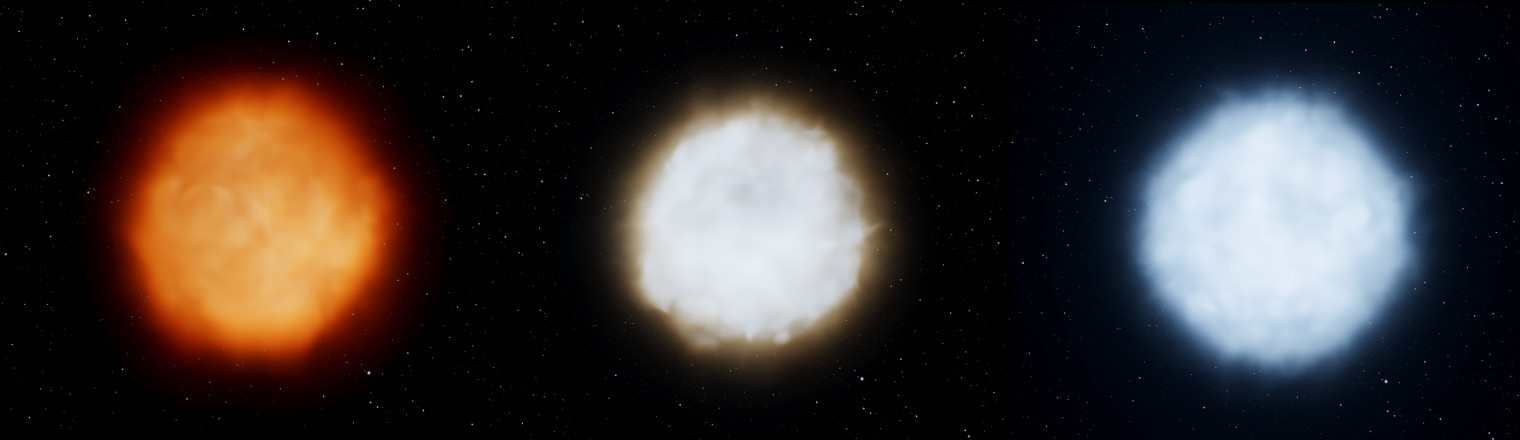
In addition to the Main Sequence stars, I also made visual effects for supergiant stars and Asymptotic Giant Branch (AGB) stars. These are both types of stars that are much larger than our Sun. Supergiants are the largest stars in the universe, with some having a radius more than 1000 times that of the Sun. AGB stars are also very large and are in a late stage of stellar evolution. While these stars are much larger than their Main Sequence counterparts, they are not more massive. Instead, their outer layers are very diffuse. They are so diffuse in fact, that they do not have a well-defined surface at all. They appear as fuzzy blobs, unlike Main Sequence stars. Here are some of the physical effects I implemented in the visuals of these stars:
- Colors: Just like the Main Sequence stars, the colors of the supergiants and AGB stars are based on physical models of stellar atmospheres combined with the sensitivity curve of the human eye, to get colors that are exactly what a human would see in real life.
- Outer Atmosphere: The outer atmospheres of supergiants and AGB stars are very extended. I implemented this in the visuals by rendering the stars using ray tracing, correctly capturing the way light travels through the star's atmosphere. By describing the temperature and density of the star's atmosphere, we get a realistic look for the star, including effects like limb darkening.
- Convective cells: The surfaces of supergiants and AGB stars are very dynamic and have large convective cells that create large, dark surface features. These features change and evolve over time, which adds a lot of visual interest to the stars. Contrary to the Main Sequence stars, these convective cells are a significant fraction of the star's radius, deforming the its shape. Unlike Main Sequence stars, these stars are not round!